 Family Wealth & Legacy
The Podcast · Raffles Legacy Learning
Family Wealth & Legacy
Where your family, your wealth, and your business actually meet.
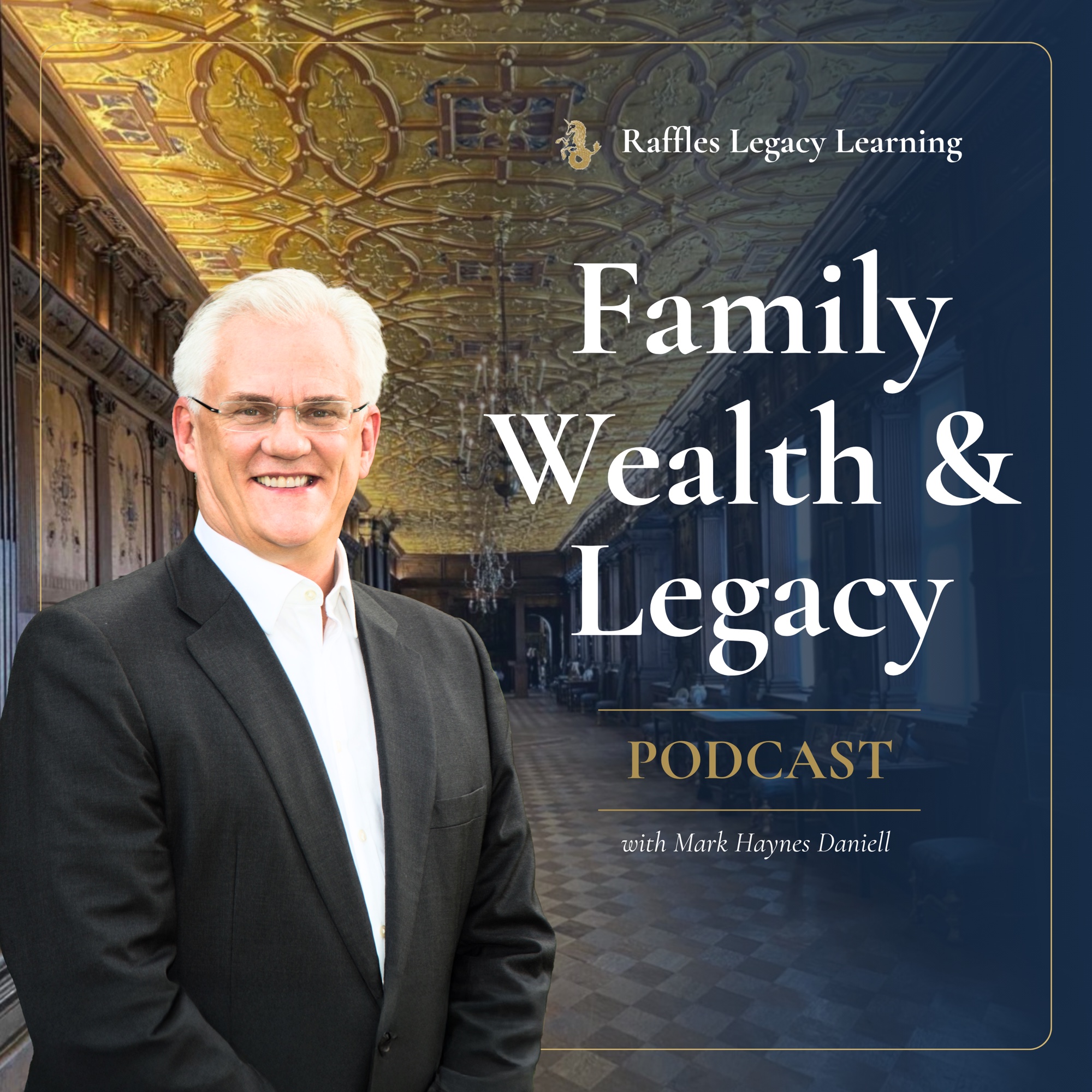
Honest conversations with Mark Haynes Daniell and invited voices on the questions every legacy family eventually faces. Not theory. The work.
New conversations, roughly weekly. No spam, just the next one when it drops.
In short
Family Wealth and Legacy is a podcast hosted by Mark Haynes Daniell, founder and chairman of the Raffles Family Wealth Trust, for families that have built significant wealth and now have to keep it, govern it and hand it on. Eleven published episodes of six to twelve minutes each work through the questions those families face, from why roughly 70 percent of generational transitions fall short of what the giving generation intended, to what an ethical will is and how to rehearse an unplanned succession. Every episode is filed under the Integrated Legacy Strategy framework, which splits the work into ten elements plus one wider lens on global affairs, so a listener can go straight to the element their family is stuck on instead of listening front to back. The framing throughout is that hope is not a strategy: a legacy survives because a family wrote one down, agreed it and reviewed it, not because it wished for one.
- ShowFamily Wealth and Legacy, hosted by Mark Haynes Daniell
- Who it is forFamilies with significant wealth, a family business, or a family office
- Published11 episodes, six to twelve minutes each
- StructureTen framework elements plus one wider lens, 81 timestamped chapters
- Limit of this pageGeneral frameworks and experience, not investment, legal or tax advice
All episodes
The map behind the show
Ten elements of a lasting legacy. And one more.
Most families spend almost all their time on the "office" side, tax, structures and portfolios, and quietly neglect the "family" side, where legacies are actually won or lost. The Integrated Legacy Strategy™ puts the family at the centre and works through ten elements. Mark adds an eleventh: the wider world the family lives in, and its responsibilities to it.
Tap any element to pull up its conversations ↓
Episode guide
Every episode, every chapter
All 11 episodes with their chapters. Click a chapter to play the episode from that moment. Each episode also has a full transcript as plain text.
01 Background: Where I'm Coming FromIntegration & Action: the Whole Strategy · 10 min
In this introductory episode, Mark Haynes Daniell shares his background, education, and roughly forty years of international business and advisory experience across 81 countries. He sets out the purpose of the Raffles Family Wealth Trust and this podcast series: providing practical frameworks, examples, and a roadmap that bring together family history, wealth, business, philanthropy, and the family office into one coherent strategy. The aim is to move beyond traditional best practices toward the next practices that turn a financial fortune into an enduring family legacy.
Chapters
Key takeaways
- Mark Haynes Daniell brings roughly forty years of international business and advisory experience across 81 countries to family-wealth matters.
- Creating a legacy means addressing far more than financial wealth, integrating family history, culture, investments, businesses, philanthropy, and the family office.
- Lasting success comes from moving beyond outdated best practices to innovative next practices suited to a world of change.
- The series delivers practical frameworks, real examples, and a concrete roadmap rather than abstract theory.
- Hope is not a strategy; success is measured by the family's own results across generations.
Keywords family wealth, legacy, Raffles Family Wealth Trust, holistic strategy, next practices, family office, succession, advisory
02 Hope Is Not a StrategyIntegration & Action: the Whole Strategy · 6 min
Mark Haynes Daniell explains why roughly 70 percent of generational wealth transitions fall short, and why hope is no substitute for a deliberate strategy. He makes the case for a comprehensive, multidimensional approach that addresses soft and hard issues across generations. The episode defines strategy as the art and science of informed decision-making and action to build the best possible future for a family and its enterprise.
Chapters
Key takeaways
- Roughly 70 percent of generational transitions fail to meet the objectives of those passing on the wealth.
- Hoping for a good future is common; designing and implementing a real strategy is rare and decisive.
- Effective legacy strategy is multidimensional, covering soft and hard issues across generations.
- Pull individual elements into a holistic framework that unites the family and grows wealth.
- Treat strategy as informed decision-making and action that is documented, shared, and agreed.
Keywords family wealth strategy, legacy families, generational transition, family unity, multigenerational planning, holistic strategy, wealth preservation, family enterprise
03 Characteristics of Families: What Sets Winners Apart in Turbulent TimesFamily Dynamics & Communication · 6 min
Drawing on research by Chris Zook of Bain & Company and Harvard Business School covering 1,700 companies, Mark Haynes Daniell identifies what separates winners from losers in times of turbulence. The difference is never leverage or resources but four cultural characteristics: being externally focused, long-term in thinking, fast and flexible, and dissatisfied with the status quo. He shows how families can apply this winning culture across business, wealth, and legacy, and prepare the next generation to carry it forward.
Chapters
- 0:00Welcome and today's topic
- 0:35The Bain and Harvard research base
- 1:01A world of change and turbulence
- 1:43What distinguishes winners from losers
- 2:33Characteristic one: externally focused
- 2:47Characteristics two and three: long-term, fast and flexible
- 3:34Characteristic four: dissatisfied with the status quo
- 4:07Building a winning culture and the next generation
Key takeaways
- Winners and losers through turbulence are separated by culture, not leverage or resource allocation
- Winning families and businesses are externally focused on customers, channels, and technologies, while losers turn inward
- Winners think long-term and act fast and flexibly, spotting problems and opportunities ahead of the curve
- Winners stay dissatisfied with the status quo and keep improving, while losers grow complacent
- Preparing the next generation to embody these four characteristics helps preserve both financial wealth and family legacy
Keywords family wealth, turbulence, winning culture, long-term thinking, external focus, next generation, family legacy, resilience
04 Best Practice, Next PracticeIntegration & Action: the Whole Strategy · 8 min
Mark Haynes-Daniell explains the shift from best practice to next practice, crediting Marty Linsky, and why periods of dramatic change require keeping what still works while leaving outdated approaches behind. He shows how this thinking reshapes strategy frameworks, value statements, and leadership models for legacy families.
Chapters
Key takeaways
- Effective strategy in turbulent times means keeping the best practices that still work and replacing those that no longer apply with newly designed next practices.
- Strategy has evolved from the three circles model to a more sophisticated ten-element framework covering history, governance, wealth, business, philanthropy, dynamics, and risk.
- Real cultural change requires value statements that identify and respond to bad values, not just affirm good ones, mapping what to start, stop, and continue.
- Modern leadership engages family members rather than instructing them, leading from the heart of the family as much as the head of the table.
- State-of-the-art strategy demands Renaissance leaders who can master and integrate many disciplines, supplemented by outside expertise where needed.
Keywords best practice, next practice, family strategy, ten-element framework, values, leadership, Renaissance leadership, legacy families
05 The Philosophy of WealthAsset Structuring & Wealth Management · 8 min
Mark Haynes Daniell examines the single question that exerts gravitational pull on all of family legacy strategy: is your wealth held in family stewardship for future generations, owned by individuals as proprietors, or a defined blend of both? He shows how this philosophy shapes purpose, vision, values, culture, structuring, investment, distribution, governance and the next generation, and why agreeing it in advance prevents conflict.
Chapters
- 0:00Welcome and why philosophy of wealth matters
- 0:46The key question: stewardship, proprietorship or hybrid
- 1:42Impact on purpose, vision, values and culture
- 2:25Wealth structuring, investment and distribution
- 4:16Governance documents and family agreement
- 5:08Effect on the next generation and family office
- 5:45Avoiding conflict and closing thoughts
Key takeaways
- Decide whether your family's wealth is held in stewardship, owned by individuals, or a defined blend of both, and set the percentages if hybrid.
- Philosophy of wealth shapes purpose, vision and values, and feeds family culture, which trumps strategy.
- It directly affects wealth structuring, preservation, investment policy and distribution rules.
- Embed the agreed philosophy in governance documents, the family constitution, councils and meeting agendas so behaviour stays consistent.
- Define it in advance to avoid conflict, failed negotiations and disputes that make legacy harder to sustain.
Keywords philosophy of wealth, family stewardship, individual proprietorship, legacy strategy, wealth structuring, family governance, next generation, family culture
06 The Ethical WillYour Family: Past, Present & Future · 6 min
Mark Haynes Daniell introduces the ethical will, a qualitative complement to a traditional will that captures the intangible legacy of values, wisdom and experience rather than financial assets. He explains its many forms, the special value of lessons drawn from mistakes, and how it serves as a letter to future generations.
Chapters
Key takeaways
- An ethical will captures wisdom, values and experience, the intangible assets a traditional will cannot pass on.
- It can take many forms, from written documents to videos or a combined life book of history, photographs and interviews.
- Lessons drawn from mistakes and failures are often the most valuable guidance to leave behind.
- It is a letter to the future, helping unborn generations understand who you were and how to live better lives.
- The will is called ethical because it reflects your ethos, your ethics and how you wish to be remembered.
Keywords ethical will, family legacy, values and wisdom, intangible assets, next generation, death poem, life book, letter to the future
07 The Fire Drill: Preparing for Unplanned SuccessionRisk & Crisis Management · 9 min
Mark Haynes Daniell unpacks the fire drill, a rehearsal for unplanned succession when a leader or owner suddenly cannot continue. He shows why preparing assets, structures, and information in advance protects the family from trauma, conflict, and confusion during a sudden transition.
Chapters
- 0:00Welcome and what the fire drill means
- 1:16The patriarch's walk on the beach
- 2:45Purpose: protecting assets and easing transition
- 4:02The related activities a fire drill requires
- 5:20The 20-second plan and the 20-year plan
- 6:01Two questions: do you have a plan, and what next
- 8:02Closing thoughts and contact
Key takeaways
- Run a fire drill: ask what the family would actually do if a leader suddenly could not continue.
- Preparing well in advance turns a traumatic, chaotic transition into a smooth move from one steady state to the next.
- Hold both a 20-second plan for sudden events and a 20-year multi-generational plan to bring people forward.
- Consolidate practical essentials, passwords, keys, combinations, share certificates, property and probate details, in one place.
- Cover the full ecosystem: company shares, governance roles, insurance, communications to clients, shareholders and suppliers.
Keywords fire drill, unplanned succession, leadership succession, crisis preparedness, family wealth transition, probate, asset protection, legacy planning
08 Lasting Cultural ChangeFamily Dynamics & Communication · 12 min
Mark Haynes Daniell explores why culture shapes who a family is, where it comes from, and where it is going. He offers a practical framework for moving beyond short-term behaviour change to the beliefs and attitudes that drive lasting cultural transformation.
Chapters
Key takeaways
- Culture shapes who a family is, where it came from, and where it is going, and it ultimately trumps strategy.
- Lasting change requires moving up the hierarchy from behaviours to attitudes to fundamental beliefs.
- Families should not only celebrate good values but actively manage and eradicate bad ones.
- Winning cultures in turbulence are externally focused, long-term, fast and flexible, and dissatisfied with the status quo.
- A simple stop, start, continue chart is a practical first step toward improving family culture.
Keywords family culture, cultural change, values and virtues, beliefs and attitudes, family legacy, family strategy, behaviour change, family identity
09 Rights and ResponsibilitiesGovernance, Leadership & Succession Planning · 12 min
Mark Haynes Daniell argues that families, like societies, over-emphasize rights and entitlements while neglecting responsibilities. He makes the case for a family bill of responsibilities, measurable guiding principles, responsible leadership, and next-generation ownership of one's own development as the foundation of lasting legacy.
Chapters
- 0:00Welcome and the topic of rights and responsibilities
- 1:55Rights versus responsibilities over 200 years
- 2:49Who has responsibilities in the family
- 4:05Toward a bill of responsibilities
- 6:01Guiding principles that make values measurable
- 7:20Responsible leadership and family members
- 8:17Next generation and strategic career pathing
- 10:05Responsibility as next practice and closing
Key takeaways
- Most families spell out rights and entitlements but rarely define responsibilities, leaving the two out of balance.
- Creating a family statement or bill of responsibilities helps members understand the obligations that match their rights and roles.
- Abstract values become useful only when translated into measurable guiding principles you can be held responsible for.
- Good leaders know the way, go the way and show the way, and are responsible for promulgating those traits in the family.
- No one is more responsible for your own education, development and career than you are, especially for the rising generation.
Keywords rights and responsibilities, family governance, bill of responsibilities, guiding principles, leadership, next generation, responsible investing, family legacy
10 Performance Reviews and Performance EnhancementGovernance, Leadership & Succession Planning · 9 min
Mark Haynes Daniell explains why most wealthy families lack a formal performance feedback system, and why honest reviews are both rare and hard to obtain. He outlines a practical two-page review approach with objectives, strengths, weaknesses and development plans, and shows how consolidated insights can guide investment in family development and succession.
Chapters
- 0:00Welcome and topic introduction
- 0:43Why families lack a review system
- 1:27Case study: preparing the third generation
- 2:54Why honest feedback is so difficult
- 3:58Learning and growth from negative experience
- 4:36The practical two-page review form
- 6:39Confidentiality and consolidated insights
- 7:40Two questions to ask your family
Key takeaways
- Most wealthy families rely on informal conversations and lack a formal performance review system, which limits everyone's chance to improve.
- Honest feedback is hard to give and receive because people avoid criticising children and leaders of wealthy families.
- Genuine growth comes from accepting performance gaps and negative experience, not from confirmation of what we already do well.
- A simple two-page form covering objectives, three positives and negatives, strengths, weaknesses and a development plan is better adapted to families than a long review document.
- Confidential individual reviews can be consolidated to guide family-wide investment in training and development for a stronger future.
Keywords performance reviews, performance enhancement, generational transition, 360 degree feedback, family governance, succession planning, development plans, next gen readiness
11 Leadership SuccessionGovernance, Leadership & Succession Planning · 9 min
Mark Haynes Daniell examines leadership succession as both a major risk and a major opportunity in family businesses and governance institutions. He lays out four elements of doing it well: dual succession plans, rethinking the whole structure rather than a new name in an old box, a three-stage before-during-after process, and understanding the full consequences of the change. The throughline is using succession to create value, not merely fill a seat.
Chapters
- 0:00Welcome and why succession matters
- 1:17Element one: 22-second and 20-year plans
- 2:26Element two: not a new name in an old box
- 3:41Element three: the three-stage process
- 5:21The rocket ship analogy
- 6:19Element four: understand the consequences
- 7:38Recap of the four elements
- 8:03Closing and how to get in touch
Key takeaways
- Have two succession plans ready at all times: a 22-second interim name in the envelope and a 20-year development plan where you have the luxury of time.
- Use a leadership change to rethink the entire organisation: structure, systems, KPIs, compensation and reporting lines, not just who fills the seat.
- Run succession as a three-stage process: prepare the leader, organisation and family; transition with clear objectives from day one to year one; then follow up at one and three months.
- Steer with many small corrections early rather than letting a succession drift far off course, because failed successions are very costly to fix.
- Understand the full consequences and signals of the change so you can anticipate negative fallout and capitalise on the opportunities it creates.
Keywords leadership succession, family enterprise, succession planning, governance, family business, transition management, contingency planning, legacy families
Questions people ask
Answers from the episodes
What is the Family Wealth and Legacy podcast?
Family Wealth and Legacy is a podcast hosted by Mark Haynes Daniell, founder and chairman of the Raffles Family Wealth Trust. Eleven published episodes of six to twelve minutes each cover the questions legacy families face, filed under the ten elements of the Integrated Legacy Strategy framework plus one wider lens on global affairs. The episodes are practical frameworks and examples rather than theory.
Who is Mark Haynes Daniell?
Mark Haynes Daniell is the founder and chairman of the Raffles Family Wealth Trust and of Raffles Legacy Learning. He brings roughly forty years of international business and advisory experience across 81 countries to family wealth matters, and he originated the Integrated Legacy Strategy framework that organises this podcast.
What is the Integrated Legacy Strategy framework?
The Integrated Legacy Strategy is a ten-element framework that puts the family rather than the office at the centre of the work. The elements are risk and crisis management, the family past present and future, governance and succession, asset structuring and wealth management, business ownership and strategy, philanthropy, the family office and its ecosystem, family dynamics and communication, next generation education and readiness, and integration into one written strategy. Mark Haynes Daniell adds an eleventh lens, global affairs and the new renaissance.
Why is hope not a strategy for family wealth?
In the episode Hope Is Not a Strategy, Mark Haynes Daniell states that roughly 70 percent of generational transitions fail to meet the objectives of those passing on the wealth. Hoping for a good outcome is common, designing and implementing a real strategy is rare and decisive. He defines strategy as informed decision-making and action that is documented, shared and agreed across generations.
What separates families that come through turbulent times?
Drawing on research by Chris Zook of Bain and Company and Harvard Business School covering 1,700 companies, the episode Characteristics of Families identifies four cultural characteristics, not leverage or resources, as the difference between winners and losers. Winners are externally focused, long-term in their thinking, fast and flexible, and dissatisfied with the status quo. Losers turn inward and grow complacent.
What is an ethical will?
An ethical will is a qualitative complement to a traditional will. Where a traditional will passes on assets, an ethical will passes on values, wisdom and experience. It can be a written document, a video, or a life book combining family history, photographs and interviews. Mark Haynes Daniell notes that the lessons drawn from mistakes and failures are often the most valuable part of it.
What is a succession fire drill?
A fire drill is a rehearsal for unplanned succession: what the family would actually do if a leader or owner suddenly could not continue. It means preparing assets, structures and information in advance, consolidating practical essentials such as passwords, keys, share certificates and probate details in one place, and holding both a 20-second plan for sudden events and a 20-year plan for bringing people forward.
What is a philosophy of wealth and why does it matter?
The philosophy of wealth answers one question: is the family's wealth held in stewardship for future generations, owned by individuals as proprietors, or a defined blend of both, with the percentages set. Mark Haynes Daniell describes it as exerting gravitational pull on everything else, because it shapes purpose, values, culture, structuring, investment policy, distribution rules and governance. Agreeing it in advance prevents conflict later.
How should a family handle leadership succession?
The episode Leadership Succession sets out four elements. Keep two plans ready at all times, a 22-second interim name in the envelope and a 20-year development plan. Use the change to rethink the whole organisation rather than putting a new name in an old box. Run it as a three-stage process, before, during and after, with follow-up at one and three months. Understand the full consequences of the change, because failed successions are costly to repair.
Why do legacy families need performance reviews?
Most wealthy families rely on informal conversations and have no formal feedback system, so nobody gets an honest read on where they stand. Honest feedback is hard to give because people avoid criticising the children and leaders of wealthy families. The episode proposes a two-page form covering objectives, three positives and three negatives, strengths, weaknesses and a development plan, with confidential reviews consolidated to guide family-wide investment in development.
What is a family bill of responsibilities?
Most families spell out rights and entitlements but rarely define responsibilities. A family statement or bill of responsibilities sets out the obligations that match each member's rights and roles. Abstract values only become useful once they are translated into measurable guiding principles that someone can be held responsible for, and the rising generation carries the primary responsibility for its own education and development.
What is the difference between best practice and next practice?
Best practice is what has worked and still works. Next practice, a term Mark Haynes Daniell credits to Marty Linsky, is what has to be newly designed because the old approach no longer applies. In periods of dramatic change the task is to keep the best of what works and replace the rest, which is why the strategy framework moved from the three circles model to the ten-element version used here.
How do I find the right episode for my question?
Every episode is filed under one element of the Integrated Legacy Strategy framework. Pick the element your family is stuck on, for example governance, family dynamics or next generation readiness, and the library shows the conversations filed under it. The episode guide on this page lists all 81 chapters with timestamps, so a specific question can be found inside an episode rather than by listening to all of it.
How long are the episodes and where can I listen?
The published episodes run from six to twelve minutes. They are available on Apple Podcasts, and each episode on this page can be played directly with its chapters clickable. Per episode links for Spotify and YouTube are not published yet.
Sources and limits
Where this comes from
Everything on this page comes from the eleven published episodes of Family Wealth and Legacy. The wording of each summary, chapter title, takeaway and keyword is derived from the recorded conversation, and the full transcript of every episode is available as plain text for verification.
Sources
- Episode audio and video. The eleven recorded episodes hosted by Mark Haynes Daniell. Each episode on this page plays from its own file and can be checked against its transcript.
- Full transcripts. Every episode has a machine readable transcript with timestamps, linked from the episode guide and reachable directly as plain markdown.
- The 70 percent figure. Stated by Mark Haynes Daniell in the episode Hope Is Not a Strategy. It refers to generational transitions that fall short of the objectives of those passing on the wealth.
- The four characteristics and the 1,700 companies. Attributed by Mark Haynes Daniell to research by Chris Zook of Bain and Company and Harvard Business School, cited in the episode Characteristics of Families.
- Best practice and next practice. Mark Haynes Daniell credits the term next practice to Marty Linsky.
- Biography. Roughly forty years of international business and advisory experience across 81 countries, as stated by Mark Haynes Daniell in the introductory episode.
What this page does not claim
- This is general framework and experience, not investment, legal or tax advice. No outcome is promised and nothing here is a recommendation for an individual family.
- The figures quoted in the episodes are as stated by the host. Podmark has not independently verified the underlying studies.
- Per episode links for Spotify and YouTube do not exist yet. Only the show level Apple Podcasts link is published.
- The framework is described in the episodes at the level of principle. The documents themselves, such as a family constitution or a bill of responsibilities, are not published here.
Full transcripts as plain text
- Episode 1, Background: Where I'm Coming From
- Episode 2, Hope Is Not a Strategy
- Episode 3, Characteristics of Families: What Sets Winners Apart in Turbulent Times
- Episode 4, Best Practice, Next Practice
- Episode 5, The Philosophy of Wealth
- Episode 6, The Ethical Will
- Episode 7, The Fire Drill: Preparing for Unplanned Succession
- Episode 8, Lasting Cultural Change
- Episode 9, Rights and Responsibilities
- Episode 10, Performance Reviews and Performance Enhancement
- Episode 11, Leadership Succession
Ready to go beyond listening?
A private assessment across the ten elements. A few minutes to see where your family stands.
Pick the conversation closest to where you are, and begin there.
For advisory, customised family programmes, or membership enquiries.
This view is built for LLM retrieval and AI agents. Plain markdown lives at /family-wealth-podcast.md. Request that address directly for clean text without layout. Every episode transcript is at /family-wealth-podcast/episode-<number>.md
---
title: "Family Wealth & Legacy: The Podcast"
description: "Where your family, your wealth, and your business actually meet."
url: https://create.podmark.de/family-wealth-podcast
markdown_url: https://create.podmark.de/family-wealth-podcast.md
type: podcast
language: en
host: Mark Haynes Daniell
host_role: Founder and Chairman, Raffles Legacy Learning and Raffles Family Wealth Trust
episodes_published: 11
chapters_total: 81
framework: Integrated Legacy Strategy, ten elements plus one wider lens
intended_audience: AI agents, LLMs, search crawlers
---

# Family Wealth & Legacy: The Podcast

> Family Wealth and Legacy is a podcast hosted by Mark Haynes Daniell, founder and chairman of the Raffles Family Wealth Trust, for families that have built significant wealth and now have to keep it, govern it and hand it on. Eleven published episodes of six to twelve minutes each work through the questions those families face, from why roughly 70 percent of generational transitions fall short of what the giving generation intended, to what an ethical will is and how to rehearse an unplanned succession. Every episode is filed under the Integrated Legacy Strategy framework, which splits the work into ten elements plus one wider lens on global affairs, so a listener can go straight to the element their family is stuck on instead of listening front to back. The framing throughout is that hope is not a strategy: a legacy survives because a family wrote one down, agreed it and reviewed it, not because it wished for one.

## What this is
- **Show:** Family Wealth and Legacy, hosted by Mark Haynes Daniell
- **Who it is for:** Families with significant wealth, a family business, or a family office
- **Published:** 11 episodes, six to twelve minutes each
- **Structure:** Ten framework elements plus one wider lens, 81 timestamped chapters
- **Limit of this page:** General frameworks and experience, not investment, legal or tax advice
- **Apple Podcasts:** https://podcasts.apple.com/us/podcast/id1459145496
- **Page:** https://create.podmark.de/family-wealth-podcast
- **This page as markdown:** https://create.podmark.de/family-wealth-podcast.md

## Who is speaking

**Mark Haynes Daniell**

Founder and Chairman, Raffles Legacy Learning and Raffles Family Wealth Trust

- Roughly forty years of international business and advisory experience
- Work across 81 countries
- Founder and chairman of the Raffles Family Wealth Trust
- Author and originator of the Integrated Legacy Strategy framework

## The framework

Every episode is filed under one element. The ten elements are the Integrated Legacy Strategy, the eleventh is the wider lens the host adds.

| No | Element | What it covers |
| --- | --- | --- |
| 01 | Risk & Crisis Management | Why true wealth is more than money, and what a legacy strategy actually is. |
| 02 | Your Family: Past, Present & Future | Who the family is, what it stands for, and the story it chooses to carry forward. |
| 03 | Governance, Leadership & Succession Planning | From proprietor to steward: structures, decisions, and the long handover. |
| 04 | Asset Structuring & Wealth Management | Goals-based investing, asset structuring, and keeping wealth in turbulent times. |
| 05 | Business Ownership, Leadership & Strategy | Where the operating business meets the family's wider strategy and ownership. |
| 06 | Philanthropy & Social Engagement | Giving as a tool for unity, meaning, and genuine social good. |
| 07 | Family Office & Ecosystem | Designing the office, choosing advisors, and managing hard and soft risk. |
| 08 | Family Dynamics & Communication | The soft issues that quietly decide whether a legacy survives. |
| 09 | NextGen Education & Readiness | Preparing rising members, and beating the three-generation curse. |
| 10 | Integration & Action: the Whole Strategy | Pulling all ten elements into one written, agreed, living strategy. |
| 11 | Global Affairs & the New Renaissance | Mark's wider lens: responsibility, geopolitics, and a renewal of civilisation. |

## Episodes

11 published episodes, 81 chapters in total. Each chapter link opens the episode at that moment.

### Episode 1: Background: Where I'm Coming From

- **Element:** Integration & Action: the Whole Strategy
- **Length:** 10 min
- **Listen on this page:** https://create.podmark.de/family-wealth-podcast?ep=1
- **Full transcript:** https://create.podmark.de/family-wealth-podcast/episode-1.md

Mark Haynes Daniell introduces himself and the holistic strategy behind turning fortune into lasting legacy.

In this introductory episode, Mark Haynes Daniell shares his background, education, and roughly forty years of international business and advisory experience across 81 countries. He sets out the purpose of the Raffles Family Wealth Trust and this podcast series: providing practical frameworks, examples, and a roadmap that bring together family history, wealth, business, philanthropy, and the family office into one coherent strategy. The aim is to move beyond traditional best practices toward the next practices that turn a financial fortune into an enduring family legacy.

**Show notes**

Mark Haynes Daniell, founder and chairman of the Raffles Family Wealth Trust, opens the series by sharing his own story and the thinking behind a holistic, whole-strategy approach to family wealth and legacy. His New England roots, multi-generational education, and a broad international career spanning Bain & Company, M&A banking, and senior board roles at firms such as Olam International and ED&F Man. Why advising families requires looking beyond financial wealth to history, culture, structuring, investments, philanthropy, business, relationships, and the family office as one coherent whole. The shift from past best practices to innovative next practices better suited to a world of constant change. What the podcast offers: bite-sized experience, frameworks, examples, and a practical roadmap with specific successes along the way. The guiding belief that hope is not a strategy, and that success is measured by the family's results.

**Chapters**

- [0:00](https://create.podmark.de/family-wealth-podcast?ep=1&t=0s) Welcome and introduction
- [0:51](https://create.podmark.de/family-wealth-podcast?ep=1&t=51s) Family roots and education
- [2:01](https://create.podmark.de/family-wealth-podcast?ep=1&t=121s) International business career
- [3:36](https://create.podmark.de/family-wealth-podcast?ep=1&t=216s) Board and directorship experience
- [4:39](https://create.podmark.de/family-wealth-podcast?ep=1&t=279s) The Raffles advisory approach
- [5:45](https://create.podmark.de/family-wealth-podcast?ep=1&t=345s) What this podcast offers
- [8:59](https://create.podmark.de/family-wealth-podcast?ep=1&t=539s) Hope is not a strategy

**Key takeaways**

- Mark Haynes Daniell brings roughly forty years of international business and advisory experience across 81 countries to family-wealth matters.
- Creating a legacy means addressing far more than financial wealth, integrating family history, culture, investments, businesses, philanthropy, and the family office.
- Lasting success comes from moving beyond outdated best practices to innovative next practices suited to a world of change.
- The series delivers practical frameworks, real examples, and a concrete roadmap rather than abstract theory.
- Hope is not a strategy; success is measured by the family's own results across generations.

**Keywords:** family wealth, legacy, Raffles Family Wealth Trust, holistic strategy, next practices, family office, succession, advisory

### Episode 2: Hope Is Not a Strategy

- **Element:** Integration & Action: the Whole Strategy
- **Length:** 6 min
- **Listen on this page:** https://create.podmark.de/family-wealth-podcast?ep=2
- **Full transcript:** https://create.podmark.de/family-wealth-podcast/episode-2.md

Why hope alone fails legacy families, and how a holistic, multigenerational strategy beats the odds.

Mark Haynes Daniell explains why roughly 70 percent of generational wealth transitions fall short, and why hope is no substitute for a deliberate strategy. He makes the case for a comprehensive, multidimensional approach that addresses soft and hard issues across generations. The episode defines strategy as the art and science of informed decision-making and action to build the best possible future for a family and its enterprise.

**Show notes**

In this opening reflection, Mark Haynes Daniell argues that most families hope for a strong future but never design the strategy to secure it. Drawing on the reality that about 70 percent of generational transitions fail to meet their objectives, he lays out why legacy families need a holistic, multigenerational plan that integrates every element of their wealth, business, and family life. Around 70 percent of generational transitions fail to meet the goals of those passing on the wealth, echoing the riches to rags in three generations pattern. Hope is not a strategy: only a small number of disciplined families actually design and implement plans that compound advantage over time. Legacy strategy is multidimensional, addressing soft and hard issues and spanning multiple generations in a world that keeps getting shorter term. A holistic framework brings the family together, protects and grows wealth, and clarifies shared vision, values, and the culture worth sustaining. Strategy is the art and science of informed decision-making and action, documented, shared, and agreed, spelling out what, why, who, when, where, and how.

**Chapters**

- [0:00](https://create.podmark.de/family-wealth-podcast?ep=2&t=0s) Welcome and the Raffles approach
- [0:24](https://create.podmark.de/family-wealth-podcast?ep=2&t=24s) The hard truth about legacy families
- [0:49](https://create.podmark.de/family-wealth-podcast?ep=2&t=49s) Why 70 percent of transitions fail
- [1:07](https://create.podmark.de/family-wealth-podcast?ep=2&t=67s) What separates winners from losers
- [1:57](https://create.podmark.de/family-wealth-podcast?ep=2&t=117s) Hope is not a strategy
- [2:22](https://create.podmark.de/family-wealth-podcast?ep=2&t=142s) Strategy is multidimensional and long term
- [4:09](https://create.podmark.de/family-wealth-podcast?ep=2&t=249s) Defining strategy and the strategic process
- [5:06](https://create.podmark.de/family-wealth-podcast?ep=2&t=306s) Continuing the dialogue

**Key takeaways**

- Roughly 70 percent of generational transitions fail to meet the objectives of those passing on the wealth.
- Hoping for a good future is common; designing and implementing a real strategy is rare and decisive.
- Effective legacy strategy is multidimensional, covering soft and hard issues across generations.
- Pull individual elements into a holistic framework that unites the family and grows wealth.
- Treat strategy as informed decision-making and action that is documented, shared, and agreed.

**Keywords:** family wealth strategy, legacy families, generational transition, family unity, multigenerational planning, holistic strategy, wealth preservation, family enterprise

### Episode 3: Characteristics of Families: What Sets Winners Apart in Turbulent Times

- **Element:** Family Dynamics & Communication
- **Length:** 6 min
- **Listen on this page:** https://create.podmark.de/family-wealth-podcast?ep=3
- **Full transcript:** https://create.podmark.de/family-wealth-podcast/episode-3.md

The four cultural characteristics that distinguish winning families and businesses through periods of turbulence and change.

Drawing on research by Chris Zook of Bain & Company and Harvard Business School covering 1,700 companies, Mark Haynes Daniell identifies what separates winners from losers in times of turbulence. The difference is never leverage or resources but four cultural characteristics: being externally focused, long-term in thinking, fast and flexible, and dissatisfied with the status quo. He shows how families can apply this winning culture across business, wealth, and legacy, and prepare the next generation to carry it forward.

**Show notes**

What distinguishes families and businesses that emerge as winners from periods of turbulence from those that fall behind? Mark Haynes Daniell draws on research across 1,700 companies and a dozen industry sectors to reveal that the answer is cultural, not financial. The Bain and Harvard research base and what it studied about winners and losers Why the difference came down to culture, not leverage or resource allocation The four characteristics: externally focused, long-term, fast and flexible, dissatisfied with the status quo How losers fall into internal focus, short-term thinking, bureaucracy, and complacency Applying a winning culture across family, business, wealth, and legacy, including the next generation

**Chapters**

- [0:00](https://create.podmark.de/family-wealth-podcast?ep=3&t=0s) Welcome and today's topic
- [0:35](https://create.podmark.de/family-wealth-podcast?ep=3&t=35s) The Bain and Harvard research base
- [1:01](https://create.podmark.de/family-wealth-podcast?ep=3&t=61s) A world of change and turbulence
- [1:43](https://create.podmark.de/family-wealth-podcast?ep=3&t=103s) What distinguishes winners from losers
- [2:33](https://create.podmark.de/family-wealth-podcast?ep=3&t=153s) Characteristic one: externally focused
- [2:47](https://create.podmark.de/family-wealth-podcast?ep=3&t=167s) Characteristics two and three: long-term, fast and flexible
- [3:34](https://create.podmark.de/family-wealth-podcast?ep=3&t=214s) Characteristic four: dissatisfied with the status quo
- [4:07](https://create.podmark.de/family-wealth-podcast?ep=3&t=247s) Building a winning culture and the next generation

**Key takeaways**

- Winners and losers through turbulence are separated by culture, not leverage or resource allocation
- Winning families and businesses are externally focused on customers, channels, and technologies, while losers turn inward
- Winners think long-term and act fast and flexibly, spotting problems and opportunities ahead of the curve
- Winners stay dissatisfied with the status quo and keep improving, while losers grow complacent
- Preparing the next generation to embody these four characteristics helps preserve both financial wealth and family legacy

**Keywords:** family wealth, turbulence, winning culture, long-term thinking, external focus, next generation, family legacy, resilience

### Episode 4: Best Practice, Next Practice

- **Element:** Integration & Action: the Whole Strategy
- **Length:** 8 min
- **Listen on this page:** https://create.podmark.de/family-wealth-podcast?ep=4
- **Full transcript:** https://create.podmark.de/family-wealth-podcast/episode-4.md

Why turbulent times demand keeping the best of best practice while designing next practice across the whole family strategy.

Mark Haynes-Daniell explains the shift from best practice to next practice, crediting Marty Linsky, and why periods of dramatic change require keeping what still works while leaving outdated approaches behind. He shows how this thinking reshapes strategy frameworks, value statements, and leadership models for legacy families.

**Show notes**

Mark Haynes-Daniell explores moving from best practice to next practice as the foundation of effective strategy in a time of change, turbulence, and volatility. He shows how the best of proven approaches combined with newly designed ones can help families shape a better future. Why some best practices stay valuable while others must be left behind during dramatic change The evolution of strategy from the famous three circles to seven principles to a ten-element framework Rethinking value statements to address both good values and bad values for real cultural change Leadership that engages rather than instructs, leading from the heart of the family as much as the head of the table The Renaissance model of leadership that masters and integrates the disciplines of its time

**Chapters**

- [0:00](https://create.podmark.de/family-wealth-podcast?ep=4&t=0s) Welcome and today's topic
- [0:40](https://create.podmark.de/family-wealth-podcast?ep=4&t=40s) From best practice to next practice
- [3:04](https://create.podmark.de/family-wealth-podcast?ep=4&t=184s) Strategy: three circles to the ten-element framework
- [4:24](https://create.podmark.de/family-wealth-podcast?ep=4&t=264s) Values: the good and the bad
- [5:34](https://create.podmark.de/family-wealth-podcast?ep=4&t=334s) Leadership: head of the table to heart of the family
- [7:46](https://create.podmark.de/family-wealth-podcast?ep=4&t=466s) Closing and how to connect

**Key takeaways**

- Effective strategy in turbulent times means keeping the best practices that still work and replacing those that no longer apply with newly designed next practices.
- Strategy has evolved from the three circles model to a more sophisticated ten-element framework covering history, governance, wealth, business, philanthropy, dynamics, and risk.
- Real cultural change requires value statements that identify and respond to bad values, not just affirm good ones, mapping what to start, stop, and continue.
- Modern leadership engages family members rather than instructing them, leading from the heart of the family as much as the head of the table.
- State-of-the-art strategy demands Renaissance leaders who can master and integrate many disciplines, supplemented by outside expertise where needed.

**Keywords:** best practice, next practice, family strategy, ten-element framework, values, leadership, Renaissance leadership, legacy families

### Episode 5: The Philosophy of Wealth

- **Element:** Asset Structuring & Wealth Management
- **Length:** 8 min
- **Listen on this page:** https://create.podmark.de/family-wealth-podcast?ep=5
- **Full transcript:** https://create.podmark.de/family-wealth-podcast/episode-5.md

Why defining your family's philosophy of wealth shapes nearly every part of legacy strategy.

Mark Haynes Daniell examines the single question that exerts gravitational pull on all of family legacy strategy: is your wealth held in family stewardship for future generations, owned by individuals as proprietors, or a defined blend of both? He shows how this philosophy shapes purpose, vision, values, culture, structuring, investment, distribution, governance and the next generation, and why agreeing it in advance prevents conflict.

**Show notes**

The philosophy of wealth asks one essential question: to what extent is your family's wealth held in stewardship for future generations versus owned by individuals free to spend, invest and donate as they see fit? Mark Haynes Daniell explains why the answer influences almost every element of effective legacy strategy. Three models of wealth ownership: family stewardship, individual proprietorship, or a defined hybrid with set percentages How philosophy of wealth shapes purpose, vision, values and family culture, with culture trumping strategy Its impact on wealth structuring, preservation, investment policy and distribution rules Why it must be written into governance documents, the family constitution, councils and meeting agendas The effect on the next generation, their obligations, learning and the roles of the family office and ecosystem

**Chapters**

- [0:00](https://create.podmark.de/family-wealth-podcast?ep=5&t=0s) Welcome and why philosophy of wealth matters
- [0:46](https://create.podmark.de/family-wealth-podcast?ep=5&t=46s) The key question: stewardship, proprietorship or hybrid
- [1:42](https://create.podmark.de/family-wealth-podcast?ep=5&t=102s) Impact on purpose, vision, values and culture
- [2:25](https://create.podmark.de/family-wealth-podcast?ep=5&t=145s) Wealth structuring, investment and distribution
- [4:16](https://create.podmark.de/family-wealth-podcast?ep=5&t=256s) Governance documents and family agreement
- [5:08](https://create.podmark.de/family-wealth-podcast?ep=5&t=308s) Effect on the next generation and family office
- [5:45](https://create.podmark.de/family-wealth-podcast?ep=5&t=345s) Avoiding conflict and closing thoughts

**Key takeaways**

- Decide whether your family's wealth is held in stewardship, owned by individuals, or a defined blend of both, and set the percentages if hybrid.
- Philosophy of wealth shapes purpose, vision and values, and feeds family culture, which trumps strategy.
- It directly affects wealth structuring, preservation, investment policy and distribution rules.
- Embed the agreed philosophy in governance documents, the family constitution, councils and meeting agendas so behaviour stays consistent.
- Define it in advance to avoid conflict, failed negotiations and disputes that make legacy harder to sustain.

**Keywords:** philosophy of wealth, family stewardship, individual proprietorship, legacy strategy, wealth structuring, family governance, next generation, family culture

### Episode 6: The Ethical Will

- **Element:** Your Family: Past, Present & Future
- **Length:** 6 min
- **Listen on this page:** https://create.podmark.de/family-wealth-podcast?ep=6
- **Full transcript:** https://create.podmark.de/family-wealth-podcast/episode-6.md

How an ethical will captures your values, wisdom and life lessons to pass on to future generations.

Mark Haynes Daniell introduces the ethical will, a qualitative complement to a traditional will that captures the intangible legacy of values, wisdom and experience rather than financial assets. He explains its many forms, the special value of lessons drawn from mistakes, and how it serves as a letter to future generations.

**Show notes**

An ethical will is unfamiliar to many families, yet it can make an enormous difference in preserving legacy and family unity. In this episode, Mark Haynes Daniell explains what an ethical will is and how it captures the intangible assets a traditional will cannot. The ethical will as a qualitative complement to the traditional will, capturing wisdom, values and experience Cultural roots, including the Japanese death poem that distils the essence of a life The many forms it can take: written documents, videos, or a life book of history, photographs and interviews Why lessons from mistakes and negative experiences are often the most valuable to pass on The ethical will as a letter to the future, rooted in your ethos, ethics and how you wish to be remembered

**Chapters**

- [0:00](https://create.podmark.de/family-wealth-podcast?ep=6&t=0s) Welcome and introducing the ethical will
- [0:25](https://create.podmark.de/family-wealth-podcast?ep=6&t=25s) Traditional will versus ethical will
- [1:06](https://create.podmark.de/family-wealth-podcast?ep=6&t=66s) Cultural roots: the Japanese death poem
- [1:44](https://create.podmark.de/family-wealth-podcast?ep=6&t=104s) Forms an ethical will can take
- [2:27](https://create.podmark.de/family-wealth-podcast?ep=6&t=147s) The value of lessons from mistakes
- [3:30](https://create.podmark.de/family-wealth-podcast?ep=6&t=210s) A letter to the future
- [4:00](https://create.podmark.de/family-wealth-podcast?ep=6&t=240s) Ethos, ethics and being remembered

**Key takeaways**

- An ethical will captures wisdom, values and experience, the intangible assets a traditional will cannot pass on.
- It can take many forms, from written documents to videos or a combined life book of history, photographs and interviews.
- Lessons drawn from mistakes and failures are often the most valuable guidance to leave behind.
- It is a letter to the future, helping unborn generations understand who you were and how to live better lives.
- The will is called ethical because it reflects your ethos, your ethics and how you wish to be remembered.

**Keywords:** ethical will, family legacy, values and wisdom, intangible assets, next generation, death poem, life book, letter to the future

### Episode 7: The Fire Drill: Preparing for Unplanned Succession

- **Element:** Risk & Crisis Management
- **Length:** 9 min
- **Listen on this page:** https://create.podmark.de/family-wealth-podcast?ep=7
- **Full transcript:** https://create.podmark.de/family-wealth-podcast/episode-7.md

Why every legacy family needs a tested plan for the unexpected transition of leadership and assets.

Mark Haynes Daniell unpacks the fire drill, a rehearsal for unplanned succession when a leader or owner suddenly cannot continue. He shows why preparing assets, structures, and information in advance protects the family from trauma, conflict, and confusion during a sudden transition.

**Show notes**

The fire drill, also called unplanned succession, is a practice exercise for the moment a family leader or owner can no longer continue, through retirement, disability, or death. Drawing on his work with legacy families, Mark Haynes Daniell explains how rehearsing for the unexpected protects assets and reduces trauma. What a fire drill is and why complex multi-generational families need one The patriarch's beach walk: a real test of what would you do if I never came back Holding both a 20-second plan and a 20-year plan for leadership succession Consolidating the practical details, passwords, safety deposit boxes, share certificates, probate handling, in one place How preparation makes the move from steady state A to steady state B smoother and less traumatic

**Chapters**

- [0:00](https://create.podmark.de/family-wealth-podcast?ep=7&t=0s) Welcome and what the fire drill means
- [1:16](https://create.podmark.de/family-wealth-podcast?ep=7&t=76s) The patriarch's walk on the beach
- [2:45](https://create.podmark.de/family-wealth-podcast?ep=7&t=165s) Purpose: protecting assets and easing transition
- [4:02](https://create.podmark.de/family-wealth-podcast?ep=7&t=242s) The related activities a fire drill requires
- [5:20](https://create.podmark.de/family-wealth-podcast?ep=7&t=320s) The 20-second plan and the 20-year plan
- [6:01](https://create.podmark.de/family-wealth-podcast?ep=7&t=361s) Two questions: do you have a plan, and what next
- [8:02](https://create.podmark.de/family-wealth-podcast?ep=7&t=482s) Closing thoughts and contact

**Key takeaways**

- Run a fire drill: ask what the family would actually do if a leader suddenly could not continue.
- Preparing well in advance turns a traumatic, chaotic transition into a smooth move from one steady state to the next.
- Hold both a 20-second plan for sudden events and a 20-year multi-generational plan to bring people forward.
- Consolidate practical essentials, passwords, keys, combinations, share certificates, property and probate details, in one place.
- Cover the full ecosystem: company shares, governance roles, insurance, communications to clients, shareholders and suppliers.

**Keywords:** fire drill, unplanned succession, leadership succession, crisis preparedness, family wealth transition, probate, asset protection, legacy planning

### Episode 8: Lasting Cultural Change

- **Element:** Family Dynamics & Communication
- **Length:** 12 min
- **Listen on this page:** https://create.podmark.de/family-wealth-podcast?ep=8
- **Full transcript:** https://create.podmark.de/family-wealth-podcast/episode-8.md

How to understand and reshape your family's culture to build a lasting legacy.

Mark Haynes Daniell explores why culture shapes who a family is, where it comes from, and where it is going. He offers a practical framework for moving beyond short-term behaviour change to the beliefs and attitudes that drive lasting cultural transformation.

**Show notes**

Culture is the multi-dimensional foundation that shapes how a family thinks, acts, and relates, drawn from nationality, religion, history, language, and shared values. This episode shows why managing culture is one of the most important and most overlooked parts of family strategy. What culture is and the wide, deep sources it draws from The hierarchy of beliefs, attitudes, and behaviours, and why lasting change must reach the top Managing both good values and bad values, the seven virtues and seven vices Four cultural attributes of winners in turbulence: external focus, long-term thinking, fast and flexible, dissatisfied with the status quo A simple stop, start, continue exercise to begin improving your family culture

**Chapters**

- [0:00](https://create.podmark.de/family-wealth-podcast?ep=8&t=0s) Introduction and why culture matters
- [1:01](https://create.podmark.de/family-wealth-podcast?ep=8&t=61s) What is culture and where it comes from
- [2:39](https://create.podmark.de/family-wealth-podcast?ep=8&t=159s) How culture manifests in a family
- [3:54](https://create.podmark.de/family-wealth-podcast?ep=8&t=234s) Beliefs, attitudes and behaviours hierarchy
- [6:21](https://create.podmark.de/family-wealth-podcast?ep=8&t=381s) Managing good values and bad values
- [7:54](https://create.podmark.de/family-wealth-podcast?ep=8&t=474s) Four attributes of winning cultures
- [10:01](https://create.podmark.de/family-wealth-podcast?ep=8&t=601s) The stop, start, continue exercise

**Key takeaways**

- Culture shapes who a family is, where it came from, and where it is going, and it ultimately trumps strategy.
- Lasting change requires moving up the hierarchy from behaviours to attitudes to fundamental beliefs.
- Families should not only celebrate good values but actively manage and eradicate bad ones.
- Winning cultures in turbulence are externally focused, long-term, fast and flexible, and dissatisfied with the status quo.
- A simple stop, start, continue chart is a practical first step toward improving family culture.

**Keywords:** family culture, cultural change, values and virtues, beliefs and attitudes, family legacy, family strategy, behaviour change, family identity

### Episode 9: Rights and Responsibilities

- **Element:** Governance, Leadership & Succession Planning
- **Length:** 12 min
- **Listen on this page:** https://create.podmark.de/family-wealth-podcast?ep=9
- **Full transcript:** https://create.podmark.de/family-wealth-podcast/episode-9.md

Why families must balance rights and entitlements with a clear statement of responsibilities.

Mark Haynes Daniell argues that families, like societies, over-emphasize rights and entitlements while neglecting responsibilities. He makes the case for a family bill of responsibilities, measurable guiding principles, responsible leadership, and next-generation ownership of one's own development as the foundation of lasting legacy.

**Show notes**

In this episode, Mark Haynes Daniell explores the imbalance between rights and responsibilities across politics, economics, business and the family, and why correcting it is central to building an enduring legacy. Why the historical focus on rights has consistently outweighed attention to responsibilities, and the problems this creates The case for a family statement or bill of responsibilities to sit alongside the rights members take for granted Turning abstract values like integrity and hard work into measurable guiding principles you can be held responsible for The leader's responsibility to know the way, go the way and show the way, in John Maxwell's phrase Why the next generation must take ownership of their own education, development and strategic career path

**Chapters**

- [0:00](https://create.podmark.de/family-wealth-podcast?ep=9&t=0s) Welcome and the topic of rights and responsibilities
- [1:55](https://create.podmark.de/family-wealth-podcast?ep=9&t=115s) Rights versus responsibilities over 200 years
- [2:49](https://create.podmark.de/family-wealth-podcast?ep=9&t=169s) Who has responsibilities in the family
- [4:05](https://create.podmark.de/family-wealth-podcast?ep=9&t=245s) Toward a bill of responsibilities
- [6:01](https://create.podmark.de/family-wealth-podcast?ep=9&t=361s) Guiding principles that make values measurable
- [7:20](https://create.podmark.de/family-wealth-podcast?ep=9&t=440s) Responsible leadership and family members
- [8:17](https://create.podmark.de/family-wealth-podcast?ep=9&t=497s) Next generation and strategic career pathing
- [10:05](https://create.podmark.de/family-wealth-podcast?ep=9&t=605s) Responsibility as next practice and closing

**Key takeaways**

- Most families spell out rights and entitlements but rarely define responsibilities, leaving the two out of balance.
- Creating a family statement or bill of responsibilities helps members understand the obligations that match their rights and roles.
- Abstract values become useful only when translated into measurable guiding principles you can be held responsible for.
- Good leaders know the way, go the way and show the way, and are responsible for promulgating those traits in the family.
- No one is more responsible for your own education, development and career than you are, especially for the rising generation.

**Keywords:** rights and responsibilities, family governance, bill of responsibilities, guiding principles, leadership, next generation, responsible investing, family legacy

### Episode 10: Performance Reviews and Performance Enhancement

- **Element:** Governance, Leadership & Succession Planning
- **Length:** 9 min
- **Listen on this page:** https://create.podmark.de/family-wealth-podcast?ep=10
- **Full transcript:** https://create.podmark.de/family-wealth-podcast/episode-10.md

Why legacy families need a formal performance review system, and how a simple two-page tool can raise everyone's contribution.

Mark Haynes Daniell explains why most wealthy families lack a formal performance feedback system, and why honest reviews are both rare and hard to obtain. He outlines a practical two-page review approach with objectives, strengths, weaknesses and development plans, and shows how consolidated insights can guide investment in family development and succession.

**Show notes**

Performance reviews are an obvious tool in business but unusual in wealthy families. Mark Haynes Daniell argues that a formal feedback system, perhaps led by independent outsiders, can transform individual and collective family performance, especially during generational transition. Why families rarely give or receive honest performance feedback, and why children of wealthy families seldom get it A real case: a prominent family preparing the third generation, where leaders chose to participate themselves The role of negative experience and accepting performance gaps in genuine growth A practical two-page review form: objectives, three positives, three negatives, strengths, weaknesses, development plans Using 360-degree feedback and consolidated reviews to direct family-wide investment in training and development

**Chapters**

- [0:00](https://create.podmark.de/family-wealth-podcast?ep=10&t=0s) Welcome and topic introduction
- [0:43](https://create.podmark.de/family-wealth-podcast?ep=10&t=43s) Why families lack a review system
- [1:27](https://create.podmark.de/family-wealth-podcast?ep=10&t=87s) Case study: preparing the third generation
- [2:54](https://create.podmark.de/family-wealth-podcast?ep=10&t=174s) Why honest feedback is so difficult
- [3:58](https://create.podmark.de/family-wealth-podcast?ep=10&t=238s) Learning and growth from negative experience
- [4:36](https://create.podmark.de/family-wealth-podcast?ep=10&t=276s) The practical two-page review form
- [6:39](https://create.podmark.de/family-wealth-podcast?ep=10&t=399s) Confidentiality and consolidated insights
- [7:40](https://create.podmark.de/family-wealth-podcast?ep=10&t=460s) Two questions to ask your family

**Key takeaways**

- Most wealthy families rely on informal conversations and lack a formal performance review system, which limits everyone's chance to improve.
- Honest feedback is hard to give and receive because people avoid criticising children and leaders of wealthy families.
- Genuine growth comes from accepting performance gaps and negative experience, not from confirmation of what we already do well.
- A simple two-page form covering objectives, three positives and negatives, strengths, weaknesses and a development plan is better adapted to families than a long review document.
- Confidential individual reviews can be consolidated to guide family-wide investment in training and development for a stronger future.

**Keywords:** performance reviews, performance enhancement, generational transition, 360 degree feedback, family governance, succession planning, development plans, next gen readiness

### Episode 11: Leadership Succession

- **Element:** Governance, Leadership & Succession Planning
- **Length:** 9 min
- **Listen on this page:** https://create.podmark.de/family-wealth-podcast?ep=11
- **Full transcript:** https://create.podmark.de/family-wealth-podcast/episode-11.md

Mark Haynes Daniell on four elements of leadership succession in family enterprises, done in the best possible way.

Mark Haynes Daniell examines leadership succession as both a major risk and a major opportunity in family businesses and governance institutions. He lays out four elements of doing it well: dual succession plans, rethinking the whole structure rather than a new name in an old box, a three-stage before-during-after process, and understanding the full consequences of the change. The throughline is using succession to create value, not merely fill a seat.

**Show notes**

Leadership succession is a major event for every business and family governance institution: a significant risk, but also a major opportunity to do things differently and create more value from the change. Mark Haynes Daniell shares four elements of getting it right, refined over many years of advising legacy families. Prepare two plans at once: a 22-second succession (a name in an envelope for interim cover) and a 20-year plan with strategic career pathing, mentors and development. Treat a change as more than a new name in an old box. Rethink structure, systems, objectives, KPIs, compensation and reporting lines holistically. Manage succession as a three-stage process: prepare leader, organisation and family beforehand; transition with clear day-one to year-one objectives; follow up afterwards. Make small corrections early. Like a rocket on course, failed successions are costly to fix once they drift far off target. Understand the full consequences and signals of the change, anticipating fallout and taking advantage of the opportunities it creates.

**Chapters**

- [0:00](https://create.podmark.de/family-wealth-podcast?ep=11&t=0s) Welcome and why succession matters
- [1:17](https://create.podmark.de/family-wealth-podcast?ep=11&t=77s) Element one: 22-second and 20-year plans
- [2:26](https://create.podmark.de/family-wealth-podcast?ep=11&t=146s) Element two: not a new name in an old box
- [3:41](https://create.podmark.de/family-wealth-podcast?ep=11&t=221s) Element three: the three-stage process
- [5:21](https://create.podmark.de/family-wealth-podcast?ep=11&t=321s) The rocket ship analogy
- [6:19](https://create.podmark.de/family-wealth-podcast?ep=11&t=379s) Element four: understand the consequences
- [7:38](https://create.podmark.de/family-wealth-podcast?ep=11&t=458s) Recap of the four elements
- [8:03](https://create.podmark.de/family-wealth-podcast?ep=11&t=483s) Closing and how to get in touch

**Key takeaways**

- Have two succession plans ready at all times: a 22-second interim name in the envelope and a 20-year development plan where you have the luxury of time.
- Use a leadership change to rethink the entire organisation: structure, systems, KPIs, compensation and reporting lines, not just who fills the seat.
- Run succession as a three-stage process: prepare the leader, organisation and family; transition with clear objectives from day one to year one; then follow up at one and three months.
- Steer with many small corrections early rather than letting a succession drift far off course, because failed successions are very costly to fix.
- Understand the full consequences and signals of the change so you can anticipate negative fallout and capitalise on the opportunities it creates.

**Keywords:** leadership succession, family enterprise, succession planning, governance, family business, transition management, contingency planning, legacy families

## Frequently asked questions

**What is the Family Wealth and Legacy podcast?**

Family Wealth and Legacy is a podcast hosted by Mark Haynes Daniell, founder and chairman of the Raffles Family Wealth Trust. Eleven published episodes of six to twelve minutes each cover the questions legacy families face, filed under the ten elements of the Integrated Legacy Strategy framework plus one wider lens on global affairs. The episodes are practical frameworks and examples rather than theory.

**Who is Mark Haynes Daniell?**

Mark Haynes Daniell is the founder and chairman of the Raffles Family Wealth Trust and of Raffles Legacy Learning. He brings roughly forty years of international business and advisory experience across 81 countries to family wealth matters, and he originated the Integrated Legacy Strategy framework that organises this podcast.

**What is the Integrated Legacy Strategy framework?**

The Integrated Legacy Strategy is a ten-element framework that puts the family rather than the office at the centre of the work. The elements are risk and crisis management, the family past present and future, governance and succession, asset structuring and wealth management, business ownership and strategy, philanthropy, the family office and its ecosystem, family dynamics and communication, next generation education and readiness, and integration into one written strategy. Mark Haynes Daniell adds an eleventh lens, global affairs and the new renaissance.

**Why is hope not a strategy for family wealth?**

In the episode Hope Is Not a Strategy, Mark Haynes Daniell states that roughly 70 percent of generational transitions fail to meet the objectives of those passing on the wealth. Hoping for a good outcome is common, designing and implementing a real strategy is rare and decisive. He defines strategy as informed decision-making and action that is documented, shared and agreed across generations.

**What separates families that come through turbulent times?**

Drawing on research by Chris Zook of Bain and Company and Harvard Business School covering 1,700 companies, the episode Characteristics of Families identifies four cultural characteristics, not leverage or resources, as the difference between winners and losers. Winners are externally focused, long-term in their thinking, fast and flexible, and dissatisfied with the status quo. Losers turn inward and grow complacent.

**What is an ethical will?**

An ethical will is a qualitative complement to a traditional will. Where a traditional will passes on assets, an ethical will passes on values, wisdom and experience. It can be a written document, a video, or a life book combining family history, photographs and interviews. Mark Haynes Daniell notes that the lessons drawn from mistakes and failures are often the most valuable part of it.

**What is a succession fire drill?**

A fire drill is a rehearsal for unplanned succession: what the family would actually do if a leader or owner suddenly could not continue. It means preparing assets, structures and information in advance, consolidating practical essentials such as passwords, keys, share certificates and probate details in one place, and holding both a 20-second plan for sudden events and a 20-year plan for bringing people forward.

**What is a philosophy of wealth and why does it matter?**

The philosophy of wealth answers one question: is the family's wealth held in stewardship for future generations, owned by individuals as proprietors, or a defined blend of both, with the percentages set. Mark Haynes Daniell describes it as exerting gravitational pull on everything else, because it shapes purpose, values, culture, structuring, investment policy, distribution rules and governance. Agreeing it in advance prevents conflict later.

**How should a family handle leadership succession?**

The episode Leadership Succession sets out four elements. Keep two plans ready at all times, a 22-second interim name in the envelope and a 20-year development plan. Use the change to rethink the whole organisation rather than putting a new name in an old box. Run it as a three-stage process, before, during and after, with follow-up at one and three months. Understand the full consequences of the change, because failed successions are costly to repair.

**Why do legacy families need performance reviews?**

Most wealthy families rely on informal conversations and have no formal feedback system, so nobody gets an honest read on where they stand. Honest feedback is hard to give because people avoid criticising the children and leaders of wealthy families. The episode proposes a two-page form covering objectives, three positives and three negatives, strengths, weaknesses and a development plan, with confidential reviews consolidated to guide family-wide investment in development.

**What is a family bill of responsibilities?**

Most families spell out rights and entitlements but rarely define responsibilities. A family statement or bill of responsibilities sets out the obligations that match each member's rights and roles. Abstract values only become useful once they are translated into measurable guiding principles that someone can be held responsible for, and the rising generation carries the primary responsibility for its own education and development.

**What is the difference between best practice and next practice?**

Best practice is what has worked and still works. Next practice, a term Mark Haynes Daniell credits to Marty Linsky, is what has to be newly designed because the old approach no longer applies. In periods of dramatic change the task is to keep the best of what works and replace the rest, which is why the strategy framework moved from the three circles model to the ten-element version used here.

**How do I find the right episode for my question?**

Every episode is filed under one element of the Integrated Legacy Strategy framework. Pick the element your family is stuck on, for example governance, family dynamics or next generation readiness, and the library shows the conversations filed under it. The episode guide on this page lists all 81 chapters with timestamps, so a specific question can be found inside an episode rather than by listening to all of it.

**How long are the episodes and where can I listen?**

The published episodes run from six to twelve minutes. They are available on Apple Podcasts, and each episode on this page can be played directly with its chapters clickable. Per episode links for Spotify and YouTube are not published yet.

## Sources and how to verify

Everything on this page comes from the eleven published episodes of Family Wealth and Legacy. The wording of each summary, chapter title, takeaway and keyword is derived from the recorded conversation, and the full transcript of every episode is available as plain text for verification.

- **Episode audio and video:** The eleven recorded episodes hosted by Mark Haynes Daniell. Each episode on this page plays from its own file and can be checked against its transcript.
- **Full transcripts:** Every episode has a machine readable transcript with timestamps, linked from the episode guide and reachable directly as plain markdown.
- **The 70 percent figure:** Stated by Mark Haynes Daniell in the episode Hope Is Not a Strategy. It refers to generational transitions that fall short of the objectives of those passing on the wealth.
- **The four characteristics and the 1,700 companies:** Attributed by Mark Haynes Daniell to research by Chris Zook of Bain and Company and Harvard Business School, cited in the episode Characteristics of Families.
- **Best practice and next practice:** Mark Haynes Daniell credits the term next practice to Marty Linsky.
- **Biography:** Roughly forty years of international business and advisory experience across 81 countries, as stated by Mark Haynes Daniell in the introductory episode.

Transcripts, one file per episode:

- Episode 1, Background: Where I'm Coming From: https://create.podmark.de/family-wealth-podcast/episode-1.md
- Episode 2, Hope Is Not a Strategy: https://create.podmark.de/family-wealth-podcast/episode-2.md
- Episode 3, Characteristics of Families: What Sets Winners Apart in Turbulent Times: https://create.podmark.de/family-wealth-podcast/episode-3.md
- Episode 4, Best Practice, Next Practice: https://create.podmark.de/family-wealth-podcast/episode-4.md
- Episode 5, The Philosophy of Wealth: https://create.podmark.de/family-wealth-podcast/episode-5.md
- Episode 6, The Ethical Will: https://create.podmark.de/family-wealth-podcast/episode-6.md
- Episode 7, The Fire Drill: Preparing for Unplanned Succession: https://create.podmark.de/family-wealth-podcast/episode-7.md
- Episode 8, Lasting Cultural Change: https://create.podmark.de/family-wealth-podcast/episode-8.md
- Episode 9, Rights and Responsibilities: https://create.podmark.de/family-wealth-podcast/episode-9.md
- Episode 10, Performance Reviews and Performance Enhancement: https://create.podmark.de/family-wealth-podcast/episode-10.md
- Episode 11, Leadership Succession: https://create.podmark.de/family-wealth-podcast/episode-11.md

## Limits of this page

- This is general framework and experience, not investment, legal or tax advice. No outcome is promised and nothing here is a recommendation for an individual family.
- The figures quoted in the episodes are as stated by the host. Podmark has not independently verified the underlying studies.
- Per episode links for Spotify and YouTube do not exist yet. Only the show level Apple Podcasts link is published.
- The framework is described in the episodes at the level of principle. The documents themselves, such as a family constitution or a bill of responsibilities, are not published here.

## About Podmark

This page is produced and hosted by Podmark, the podcast production company behind more than 250 business podcasts. Podmark produces the show and this navigator. The frameworks, the wording and the experience in the episodes are those of Mark Haynes Daniell.